

Showing 1–30 of 45 resultsSorted by latest


Elevate your space with the divine Seiko RE564H Wave Symphony Melodies in Motion Clock, a celebration of music and magic. Encased in a brown and silver frame, every detail of this musical masterpiece exudes precision and elegance. As the enchanting melodies play, the dial comes to life with rotating parts adorned with Swarovski crystals, while LED lights add a touch of brilliance. With volume control and automatic shut-off, this Seiko Melodies in Motion Clock offers both beauty and functionality.

Experience elegance with the Seiko QXM470BRH Starry Night Melodies in Motion Clock. Featuring a brown plastic case with golden stars and Swarovski crystals, it boasts a one-way rotating pendulum with captivating red and blue crystals. Enjoy 12 melodies, from classics to Christmas tunes, with precise volume control and a convenient light sensor.


- Gold-tone metal case;
- Glass crystal;
- 14 colorful LED lighting fixtures;
- Light sensor;
- Demonstration button;
- One rotating pendulum;
- 28 Swarovski crystals;
- On/Off switch;

Seiko clock model qxm565brh,
This musical clock is an enthralling ornamental piece and a superb present, with Swarovski Crystals. It plays 24 melodies with motion and volume control.


Seiko QXM541BRH Special collector’s Edition is an amazing musical motion clock that will draw anyone’s attention. The clock is decorated with 22 Swarovski crystals in total and plays 18 different melodies.

The Seiko QXM553BRH Mim-Wall Philomena musical clock is certainly the right choice for everyone because of its simplicity and elegance. Oval shaped this clock is encased in a brown, wooden-like plastic case.

- 22 Swarovski Crystals – sparkling while the dial opens and moves around the clock;
- Three sets of melodies
- Plays one of 24 Hi-Fi Melodies every hour;
- A light sensor that turns off music and lights;
- One-way rotating pendulum;
- Presentation Button;
- On/Off power switch;

- 18 Hi-Fi melodies in finest quality sounds;
- One-way rotating pendulum;
- 20 Swarovski crystals;
- Features 6 colorful sparkling LED lights;
- Two spinning French Horns;

Seiko clock model QXM369BRH,
- Decorated with Swarovski crystals,
- This musical clock plays 18 beautiful melodies,
- Gold-tone metallic case.


- 12 Hi-Fi melodies from 2 selections;
- 20 colorful LED lights;
- One-way rotating pendulum;
- 16 Swarovski crystals;
- Brown wooden case;

- 15 Swarovski crystals,
- A dark brown plastic case with metallic elements,
- 5 blue Swarovski crystals rotate counter-clockwise,
- 18 Hi-Fi soft, delightful melodies.


Seiko clock model QXM250B,
12 LED lights in the blue, green and yellow color, 12 different melodies, divided into two selections, 12 red and blue Swarovski crystals.


Seiko musical clock model RE561H
- The clock plays 6 melodies,
- 20 LED lights in different colors sparkle as the melody plays,
- 4 soft pink, 4 blue, and 8 red Swarovski crystals,
- Light sensor and volume control.

- The clock plays 18 melodies each on every hour,
- 11 Swarovski crystals in red and blue,
- Melodies in Motion wall musical motion clock.


Seiko clock model FW563A,
Silver one-way rotating decorative pendulum with 4 Swarovski crystals, 6 waving flowers with 6 Swarovski crystals in blue and pink color, 12 LED lights flash playing in the rhythm of the song, Disney time clock plays 6 melodies.


Enjoy one of 6 beautiful melodies, including the opening/closing melody. Gold star-shaped wheel with four Swarovski crystals.


Seiko clock model RE572S,
- Decorated with 15 red and blue Swarovski crystals in total,
- This Seiko RE572S clock plays 18 melodies,
- Light sensor, Volume control, and Presentation button,
- Radio wave time correction function.


- 30 different melodies play, divided into three selections,
- 10 Swarovski crystals,
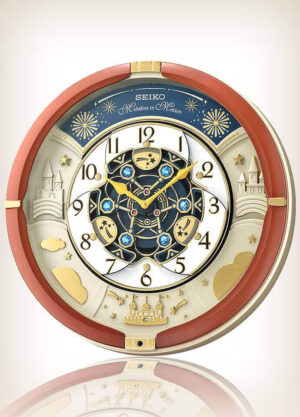

- 18 lovely melodies, divided into three different selections,
- 9 Swarovski crystals (6 blue and 3 red crystals) in total,
- Metallic light brown plastic case.

Seiko clock model FW574W/FW580W,
- Disney characters – Minnie Mouse, Mickey Mouse, and Donald Duck,
- Decorated with 15 blue and red Swarovski Crystals,
- The clock plays 12 clear and beautiful melodies.


- 18 Hi-Fi melodies are available,
- 12 Swarovski crystals (6 red and 6 blue),
- Dark-blue background with a silver metallic case.


- Seiko clock model RE579S
- Wave Symphony Musical Motion Wall Clock
- 9 Swarovski crystals in total,
- It plays 53 different melodies.

Moving Seiko Kaleidoscope wall clock plays a number of songs on the hour Clock face invert on the hour and plays one of 7 songs. Features a demonstration button and a wheel pendulum. 20 colorful, LED sparkling lights.

18.5H x 17.25W x 4.25D in.
Brown wooden case with 22 Swarovski accent crystals
Hourly strike plays 1 of 24 melodies or chimes
The clock includes an alarm, 12 hi-fi melodies, and 14 vibrant glowing LED lights synchronized with hourly melodies.


The musical clock plays 18 hi-fi melodies and has 16 Swarovski crystals arranged in different places. Brown color, resin plastic case with gold and silver additions.

Wood Grain Face with Gold-Tone Accents
Dark Brown Wooden Case
Westminster/Whittington Quarter Hour Chime
Dimensions: 17.25L x 4.25D x 18.5H in.
Brown wood case with a high gloss finish
16 Swarovski crystals adorn the clock face
Seiko clock model RE575B,
40 different melodies and five genuine Swarovski crystals.

Musical Seiko clock model RE578B,
Red and blue Swarovski crystals and 40 different beautiful melodies.
About Seiko Clocks
Kintaro Hattori opened the Seikosha factory in Tokyo in 1892 with twelve employees. The name “Seiko” — meaning precision in Japanese — wasn’t used as a brand until 1924. But that standard had been the factory’s way of working from the start.
The technical milestones are real. Seiko made the world’s first quartz wall clock for home use, setting the 32.768 kHz crystal frequency that became a global industry standard. The Pyramid Talk in the early 1980s was the world’s first talking clock. In 2013, the Space Link brought GPS satellite sync to home clocks for the first time — accurate to within one second over a million years. These aren’t marketing claims — they’re documented firsts that changed how the clock industry works.
What Seiko Makes Today
The Melodies in Motion line launched in the late 1980s and draws on Japan’s karakuri tradition — centuries-old mechanical automata designed to produce a sense of performance. On the hour, the dial face opens, splits, rotates, or unfolds while a melody plays and LED lights flash in time. The current QXM6xx generation, launched in 2024, carries 18 to 45 melodies in selectable banks: a classical set, a popular and folk set, and a Christmas set. Models range from entry-level with 12 melodies to the annual Special Collector’s Edition with 45 melodies and 22 Preciosa crystals. The Wave Symphony series and crystal-decorated models complete the Melodies in Motion range. All run on C or D batteries with a typical life of 12 to 18 months. A built-in light sensor silences the clock automatically in a dark room.
Beyond the musical line, Seiko makes pendulum wall clocks with Westminster and Whittington chime movements, radio-controlled clocks that sync to the WWVB signal from Fort Collins, Colorado, and desk, mantel, and bedside clocks. The silent sweep movement — a continuous, tick-free second hand — appears across multiple product lines. It’s one of the more practical Seiko features for bedroom or office use.
Since Rhythm closed its US distribution in January 2025, Seiko is the only major maker actively producing animated musical wall clocks in North America. That’s not a marketing claim — it’s the current state of the market.
Frequently Asked Questions
What types of clocks does Seiko make besides Melodies in Motion?
Seiko's North American lineup covers several categories beyond the animated musical line: pendulum wall clocks with Westminster and Whittington chimes, atomic R-Wave clocks that sync automatically to the WWVB radio signal, silent sweep wall clocks with a tick-free second hand, and a range of desk, mantel, bedside alarm, and travel clocks. The Melodies in Motion line is the most recognizable, but it represents one part of a broader catalog.Is Seiko a reliable clock brand?
Seiko has been manufacturing clocks since 1892 — clockmaking predates their watch business by two decades. The quartz movement standard they pioneered for home wall clocks in the late 1960s is still the global industry baseline. All Seiko clocks purchased through authorized US distributors carry a one-year warranty, and the company maintains a dedicated service center at 800-722-4452 (extension 3).Are Seiko Melodies in Motion clocks a good gift?
They tend to work well as gifts, particularly for buyers who want something more engaging than a standard wall clock. The hourly animated performance is a natural conversation piece. Special Collector's Edition models come in presentation-quality packaging. Standard QXM6xx models include batteries and instructions in the box. The main consideration for gifting is room placement — the clock needs adequate ambient light for the sensor to activate the hourly performance.Can I use a Seiko wall clock in a bedroom?
Yes — most Seiko wall clocks work well in bedrooms. Standard quartz models with a silent sweep second hand produce no ticking noise. Melodies in Motion clocks have a light sensor that automatically silences the music and animation in a dark room, so the hourly performance won't disturb sleep. The sensor activates passively — no timer or manual setting required.Questions about how the clocks work, which model fits a specific room, or what the difference is between current and discontinued models are covered in the Seiko clocks FAQ.