

Showing 1–30 of 45 resultsSorted by latest


Elevate your space with the divine Seiko RE564H Wave Symphony Melodies in Motion Clock, a celebration of music and magic. Encased in a brown and silver frame, every detail of this musical masterpiece exudes precision and elegance. As the enchanting melodies play, the dial comes to life with rotating parts adorned with Swarovski crystals, while LED lights add a touch of brilliance. With volume control and automatic shut-off, this Seiko Melodies in Motion Clock offers both beauty and functionality.

Experience elegance with the Seiko QXM470BRH Starry Night Melodies in Motion Clock. Featuring a brown plastic case with golden stars and Swarovski crystals, it boasts a one-way rotating pendulum with captivating red and blue crystals. Enjoy 12 melodies, from classics to Christmas tunes, with precise volume control and a convenient light sensor.


- Gold-tone metal case;
- Glass crystal;
- 14 colorful LED lighting fixtures;
- Light sensor;
- Demonstration button;
- One rotating pendulum;
- 28 Swarovski crystals;
- On/Off switch;

Seiko clock model qxm565brh,
This musical clock is an enthralling ornamental piece and a superb present, with Swarovski Crystals. It plays 24 melodies with motion and volume control.


Seiko QXM541BRH Special collector’s Edition is an amazing musical motion clock that will draw anyone’s attention. The clock is decorated with 22 Swarovski crystals in total and plays 18 different melodies.

The Seiko QXM553BRH Mim-Wall Philomena musical clock is certainly the right choice for everyone because of its simplicity and elegance. Oval shaped this clock is encased in a brown, wooden-like plastic case.

- 22 Swarovski Crystals – sparkling while the dial opens and moves around the clock;
- Three sets of melodies
- Plays one of 24 Hi-Fi Melodies every hour;
- A light sensor that turns off music and lights;
- One-way rotating pendulum;
- Presentation Button;
- On/Off power switch;

- 18 Hi-Fi melodies in finest quality sounds;
- One-way rotating pendulum;
- 20 Swarovski crystals;
- Features 6 colorful sparkling LED lights;
- Two spinning French Horns;

Seiko clock model QXM369BRH,
- Decorated with Swarovski crystals,
- This musical clock plays 18 beautiful melodies,
- Gold-tone metallic case.


- 12 Hi-Fi melodies from 2 selections;
- 20 colorful LED lights;
- One-way rotating pendulum;
- 16 Swarovski crystals;
- Brown wooden case;

- 15 Swarovski crystals,
- A dark brown plastic case with metallic elements,
- 5 blue Swarovski crystals rotate counter-clockwise,
- 18 Hi-Fi soft, delightful melodies.


Seiko clock model QXM250B,
12 LED lights in the blue, green and yellow color, 12 different melodies, divided into two selections, 12 red and blue Swarovski crystals.


Seiko musical clock model RE561H
- The clock plays 6 melodies,
- 20 LED lights in different colors sparkle as the melody plays,
- 4 soft pink, 4 blue, and 8 red Swarovski crystals,
- Light sensor and volume control.

- The clock plays 18 melodies each on every hour,
- 11 Swarovski crystals in red and blue,
- Melodies in Motion wall musical motion clock.


Seiko clock model FW563A,
Silver one-way rotating decorative pendulum with 4 Swarovski crystals, 6 waving flowers with 6 Swarovski crystals in blue and pink color, 12 LED lights flash playing in the rhythm of the song, Disney time clock plays 6 melodies.


Enjoy one of 6 beautiful melodies, including the opening/closing melody. Gold star-shaped wheel with four Swarovski crystals.


Seiko clock model RE572S,
- Decorated with 15 red and blue Swarovski crystals in total,
- This Seiko RE572S clock plays 18 melodies,
- Light sensor, Volume control, and Presentation button,
- Radio wave time correction function.


- 30 different melodies play, divided into three selections,
- 10 Swarovski crystals,
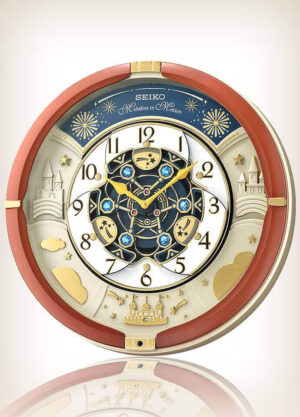

- 18 lovely melodies, divided into three different selections,
- 9 Swarovski crystals (6 blue and 3 red crystals) in total,
- Metallic light brown plastic case.

Seiko clock model FW574W/FW580W,
- Disney characters – Minnie Mouse, Mickey Mouse, and Donald Duck,
- Decorated with 15 blue and red Swarovski Crystals,
- The clock plays 12 clear and beautiful melodies.


- 18 Hi-Fi melodies are available,
- 12 Swarovski crystals (6 red and 6 blue),
- Dark-blue background with a silver metallic case.


- Seiko clock model RE579S
- Wave Symphony Musical Motion Wall Clock
- 9 Swarovski crystals in total,
- It plays 53 different melodies.

Moving Seiko Kaleidoscope wall clock plays a number of songs on the hour Clock face invert on the hour and plays one of 7 songs. Features a demonstration button and a wheel pendulum. 20 colorful, LED sparkling lights.

18.5H x 17.25W x 4.25D in.
Brown wooden case with 22 Swarovski accent crystals
Hourly strike plays 1 of 24 melodies or chimes
The clock includes an alarm, 12 hi-fi melodies, and 14 vibrant glowing LED lights synchronized with hourly melodies.


The musical clock plays 18 hi-fi melodies and has 16 Swarovski crystals arranged in different places. Brown color, resin plastic case with gold and silver additions.

Wood Grain Face with Gold-Tone Accents
Dark Brown Wooden Case
Westminster/Whittington Quarter Hour Chime
Dimensions: 17.25L x 4.25D x 18.5H in.
Brown wood case with a high gloss finish
16 Swarovski crystals adorn the clock face
Seiko clock model RE575B,
40 different melodies and five genuine Swarovski crystals.

Musical Seiko clock model RE578B,
Red and blue Swarovski crystals and 40 different beautiful melodies.
How Melodies in Motion Clocks Work
The mechanism is simpler than it looks, which is part of why it’s lasted this long. A standard quartz movement keeps time between performances. A separate motor — triggered at the top of each hour by a contact on the hour wheel — drives the dial animation. Depending on the model, the dial splits into two, three, or six sections that rotate outward, revealing decorative elements and a rotating pendulum behind. LED lights mounted inside the case flash in sync with the melody. A light sensor monitors ambient brightness and silences the clock automatically in a dark room, which handles the most common complaint about musical clocks before you even have to think about it.
Current production models are from the QXM6xx generation, which launched in 2024 as the successor to the long-running QXM3xx line. The QXM6xx models carry 18 to 45 melodies divided into two or three selectable banks — typically a classical set, a popular/folk set, and a Christmas set. Older QXM3xx models are still available through some retailers while stock lasts. Models from the QXM1xx era — the original generation that included Beatles and Broadway melodies — have been discontinued since 2009 following a copyright dispute, and now circulate only on the secondary market.
Seiko QXM Generations — Which Models Are Current
Current production models are from the QXM6xx generation, launched in 2024 as the successor to the long-running QXM3xx line. Understanding which models are which helps when you’re browsing a mix of new stock and older inventory — and there’s quite a mix out there.
- QXM1xx — The original Melodies in Motion line, produced until 2009. Played licensed popular songs — Beatles melodies, Broadway show tunes, pop hits — and were discontinued following a copyright dispute. Now appear only on the secondary market, where collector demand keeps prices firm.
- QXM2xx — Direct replacements for QXM1xx designs. Same physical mechanisms, same animated dials, but with classical melodies substituted for the discontinued licensed songs. Melody lists were either removed from the dial face or left blank.
- QXM3xx — The main international production line from roughly 2009 through 2023, the longest-running generation and the source of most Seiko Melodies in Motion clocks currently in circulation. If you find a QXM3xx model listed as new through a retailer, that’s remaining stock — not a freshly manufactured item.
- QXM4xx / QXM5xx — US-market-only editions that brought licensed popular music back for American buyers. Both discontinued for the same copyright reasons as the QXM1xx line.
- QXM6xx — Current active generation. All new international Seiko animated clocks from 2024 onward use this numbering.
- QXM9xx — Reserved for the annual Special Collector’s Editions produced exclusively for Sam’s Club.
Choosing the Right Model
The most meaningful differences between these musical clock models come down to three things: how the dial moves, how many melodies are included, and whether the model has a pendulum or not. Dial complexity ranges from a clean two-section split on entry-level models to a six-segment opening with multiple rotating inner elements on the top-tier versions — the more complex the mechanism, the more dramatic the hourly show. Pendulum Melodies in Motion models like the QXM609 and QXM617 add a swinging or rotating pendulum to the standard animated dial, giving them a more traditional clock aesthetic alongside the musical performance.
The Wave Symphony series covers the older Japan-market RE-series — predecessors to the modern QXM line, with radio wave time correction built in. These are discontinued models with limited remaining stock. The Special Collector’s Editions are the annual Sam’s Club releases — produced once per year in limited quantities, never restocked, and increasingly sought after by collectors. Models decorated with Swarovski or Preciosa crystals are grouped on the Swarovski Crystal Clocks page.
Since Rhythm closed US distribution in January 2025, Seiko is the only major brand still producing animated musical wall clocks for the North American market.
Frequently Asked Questions
What is the difference between Magic Motion and Melodies in Motion clocks?
These are two different brands, not two names for the same thing. Magic Motion is Rhythm's marketing term for their animated dial mechanism — Rhythm clocks where the dial physically splits, rotates, or unfolds on the hour. Melodies in Motion is Seiko's name for their equivalent animated musical clock line. The underlying concept is similar: a clock that performs on the hour with music and movement. Since Rhythm closed US distribution in January 2025, Seiko Melodies in Motion is now the only actively produced animated musical wall clock line available new in North America.Which Seiko Melodies in Motion model should a first-time buyer choose?
For most buyers, a mid-range QXM6xx model with 18 melodies and a standard two or three-section dial split is the right starting point — enough performance to be genuinely impressive without the complexity of the six-segment top-tier models. The QXM611BLH Cogs and Gears is a consistent recommendation: real wood frame, 13 rotating gears visible behind the dial, 18 melodies, and a price point around $330 that sits comfortably in the middle of the range. If crystal decoration matters, move up to a model with Preciosa stones on the pendulum. If melody count is the priority, look at the annual Special Collector's Edition.Do Seiko Melodies in Motion clocks work in any room?
The light sensor is the main placement consideration. The clock needs adequate ambient light during the hours you want it to perform — a room that stays naturally dark during the day may trigger the sensor and silence the clock even when you'd want it running. Living rooms, dining rooms, and hallways with normal lighting work well. Bedrooms are fine too, since the sensor silences the clock automatically once lights go off at night. Avoid placing the clock facing directly into bright sunlight, which can cause the sensor to misread ambient conditions.Not sure which model fits your space? The Seiko clocks FAQ covers mechanism details, battery life, light sensor setup, and how current and discontinued models compare.