

Showing all 12 resultsSorted by latest

Hand-cast using real crushed stone bonded with high-quality designer resin
Each piece is individually hand-painted in a multi-toned metallic finish
Exclusive to the Design Toscano brand and perfect for your home’s walls

Size : about W95cm x D108cm x H 204cm
Weight: About 480g (including batteries)
Torre & Tagus motion birdhouse clock 901658 features an animated bird beak movement and a detachable swinging pendulum. The clear, minimalist clock design makes it proper for any home or office environment.

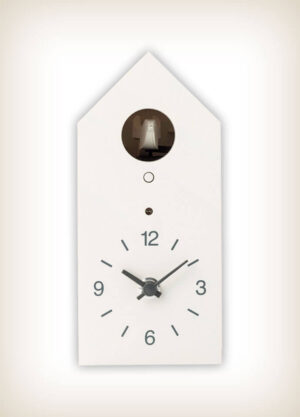
MUJI’s simple design is a very cute and lovely cuckoo clock. A piece of simple yet modernly designed cuckoo clock.


This designer’s wooden Lemnos LC17-14 the Pace cuckoo clock, pairs modern design with traditional charm.
Crafted in Japan and designed by Akira Yamamoto,
2 D batteries are included.

The Lemnos Birdhouse Clock is a cuckoo clock that tells the time with a lovely sound and the murmur of a brook. The Birdhouse Cuckoo Clock NY16-12 NT is made in Japan by Lemnos Inc., and designed by Yuichi Nara.


Make your home interior majestic with this Oak wood natural Cucuruku clock by Progetti. This Progetti Tree white cuckoo clock is made of oak wood in the shape of a rectangle.


Wonderful modern cuckoo clock CL14-1 by Rombach & Haas can make your home more urbane.

Authentic German Black Forest modern cuckoo clock RH SL35-9 with 8-day-movement by Rombach & Haas.


The large white Muji cuckoo clock is a modern update of a classic cuckoo clock featuring a light-sensitive bird that announces the hour with natural sounds. Simple and modern clock design, made by MUJI.


Lemnos CUCU is a cuckoo clock that tells the time with a lovely cuckoo sound and the murmur of a brook,
Clock is shaped like a simple birdhouse,
The Cucu LC10-16 is made in Japan by Lemnos Inc.,
Designed by Yuichi Nara.

Modern Cuckoo Clocks vs. Traditional — What’s Actually Different
The cuckoo mechanism is the common thread. On the hour, something emerges from a door or slot in the clock face and the cuckoo sound plays — whether that’s a carved bird on a linden wood clock from Triberg or a minimalist acrylic shape on a Muji wall piece. The experience is similar; the context is completely different.
Lemnos produces some of the most considered modern cuckoo clocks available — the LC17-14 Pace pairs a contemporary case design with a traditional-sounding cuckoo call, and Lemnos generally treats the cuckoo format as a design problem to solve rather than a tradition to replicate. Muji’s approach is characteristically stripped back — minimal case, no decoration, functional. Torre & Tagus leans into bird-motif design with birdhouse shapes and woodpecker pendulum clocks that share DNA with cuckoo clocks without directly being one. Kendal produces quartz cuckoo clocks in traditional-adjacent shapes at accessible price points.
None of these carry VdS certification — they’re not Black Forest products and don’t claim to be. If you want an authentic mechanical German cuckoo clock, the Black Forest collection or the chalet and carved categories are the right starting point. If you want a clock that does the cuckoo thing without looking like it belongs in an Alpine village, this is it. The Cuckoo Clocks FAQ covers movement types and what to expect from each.
Frequently Asked Questions
Are modern cuckoo clocks VdS certified?
No. VdS certification requires Black Forest manufacture and a mechanical movement — modern cuckoo clocks from Lemnos, Muji, Torre & Tagus, Kendal, and similar brands are battery-operated quartz clocks made outside Germany and meet neither criterion. That's not a quality judgment; Lemnos in particular produces well-engineered, thoughtfully designed pieces. But they belong to a completely different category from certified Black Forest clocks. If VdS certification is a requirement, the Black Forest cuckoo clock collection covers all certified options. If you want a cuckoo clock that works in a contemporary interior without the weight-driven movement and winding routine, this is the right collection.What is the difference between a modern cuckoo clock and a traditional one?
The shared feature is the hourly cuckoo call — something emerges from a door in the clock face on the hour. Everything else differs. Traditional Black Forest clocks use weight-driven mechanical movements, linden wood cases with hand carvings, and a cuckoo call produced mechanically by wooden bellows inside the case. Modern cuckoo clocks use battery-powered quartz movements, cases in metal, plastic, or minimal uncarved wood, and a digital cuckoo sound played through a small speaker. Traditional mechanical clocks need weekly winding and servicing every 8 to 10 years; modern clocks need only battery replacement every year or two.Which modern cuckoo clock brands are in this collection?
Lemnos is the most design-focused option — a Japanese clockmaker known for pairing contemporary case design with a traditional cuckoo call. Their clocks are regularly featured in design publications and treat the cuckoo format as a design problem rather than a tradition to replicate. Muji takes a characteristically minimal approach — plain case, no decoration, functional clock. Torre & Tagus and Kendal offer more accessible contemporary designs at lower price points. Browsing by brand is usually more useful than browsing by price in this collection, since each maker has a distinct design philosophy.