

Showing 1–30 of 57 resultsSorted by latest


9.25″H x 7.5″W x 6″D
Made In GERMANY
Alexander Taron Inc. was founded in 1949

German carved-style cuckoo clock with 8-day movement. Authentic black forest cuckoo clock by Hekas. The clock can be silenced manually with a lever. The melodies change every hour between the Happy Wanderer and Edelweiss.
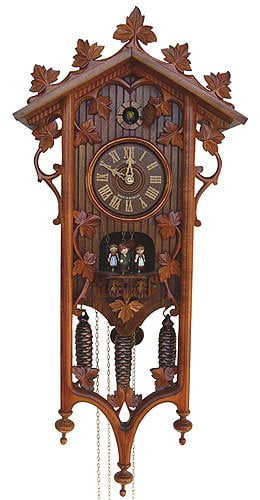
Chalet style
The 8-day rack strike movement
New wooden dial with roman numerals and hands
Features five leaves and one bird design
Plays 12 different melodies
The pendulum swings back and forth
Hand-carved solid Linden wood case with traditional walnut finish
Grape leaves, Maple leaves, carved bird top
Dimensions: 8 x 12 x 6 inches
Cuckoo bird chimes every half hour and an hour
Hand-made in Germany by skilled artisans
1-day movement
Oak stag KA 856 EX standing deer hunting cuckoo clock by Hekas with 8-day mechanical REGULA movement.


- Hand-carved roof
- 12 melodies
- Certificate of Authenticity
- Required 3 C batteries
- Night time-off sensor

The Traditional Vine Leaves cuckoo clock by Adolf Herr is adorned with hand-carved vine leaves and cuckoo chicken.

Hand-carved case with traditional walnut finish.
Grape leaves, Maple leaves, carved bird top.
Made in Germany.
Discover the allure of the Black Forest with our Trenkle TU 2028 PQ Small Kuckulino Clock. Crafted with precision, it marries traditional charm with quartz accuracy and delightful melodies. A masterpiece for every space.


This Hones HO 179/4NU cuckoo clock has an exclusive life-like wooden handpainted cuckoo. The cuckoo clock has a mechanical REGULA movement.


The chalet-style 1-day 18-51101P by August Schwer is a certified German Black Forest clock manufactured in Schwarzwald. Hand-carved and built by skillful artists this clock is 13 inches tall from top to bottom.


Rombach & Haas cuckoo clock antique 1885 replication Railroad house with delicate ornaments. The clock can be silenced manually with a lever.

The 13″ traditional 1-day Nesting Edelweiss HO 400-3ED Cuckoo Clock by Hones is a certified German Black Forest clock produced in Schwarzwald.


Small hunting cuckoo clock, very detailed carvings in the technique of the old masters. Shingled roof, wooden dial, wooden hands, wooden bird, night shut off, and 1-day running time. This August Schwer 1.0067.01.C cuckoo clock has an elite life-like wooden handpainted cuckoo.


Trenkle Quartz cuckoo clock with music 7 leaves, 3 birds TU 377 QMT. The clock plays 12 Songs.


Kendal Handcrafted Wood Cuckoo Clock MX313 features a vintage look with hand-crafted details, a sweet tone, and excellent timekeeping expertise. It is mainly produced of top-quality solid wood and surely can give the right bit of nature to your home.

The 8-day hunting cuckoo clock Romba RH 4552 with music and hanging animals has a mechanical movement from the market leader SBS-FEINTECHNIK in the Black Forest/Germany. The melodies change every hour between the Happy Wanderer and Edelweiss.

Trenkle Quartz Cuckoo Clock 6 Leaves, Bird, Grapes TU 359 Q authentic black forest premium clock by Trenkle Uhren

Trenkle Uhren Kuckulino Black Forest cuckoo clock with quartz movement and cuckoo chime, turning dancers, incl. battery TU 2018 PQ.

The best way to express the Trenkle 378 QMT hunting cuckoo clock is – a real piece of art. Hand-made with details that are breathtaking, the clock has a walnut wooden dial framed with a horn.

Dimensions: 6W x 6.5H inches
Hand-crafted from high-quality hardwoods in Germanic style
Clock finished in luxurious brown with bright accents


Carved vs. Chalet — Understanding the Difference
The distinction matters for buyers deciding between styles. Chalet cuckoo clocks are built around an architectural centrepiece — the farmhouse — with carving as decoration. Carved clocks are the opposite: the carving is the centrepiece, and the clock mechanism sits within it rather than defining it. Hunting style clocks — the most common carved type — feature a stag head at the top, antlers spreading above the roof, crossed rifles or a hunting horn framing the dial, and rabbits, pheasants, or birds positioned on the sides. Leaves and vines cover the remaining surfaces.
The carving depth varies considerably by maker and price point. Entry-level carved clocks use shallower relief work on smaller cases. Premium examples from Rombach & Haas or Hönes can stand 60 to 80 cm tall with deeply undercut three-dimensional carvings that take skilled craftsmen hours per piece. Those clocks also typically run on 8-day mechanical movements with music — a third weight for the music box, two alternating melodies, and dancing figurines behind arched doors.
If authenticity is the priority, carved clocks are where it shows most clearly. The VdS seal guarantees Black Forest origin and mechanical movement, but on a carved clock it also implies the carving itself was done in the region by trained woodcarvers. Browse the full hunting style collection or visit the Cuckoo Clocks FAQ for buying guidance.
Frequently Asked Questions
What wood is used in carved cuckoo clocks and why does it matter?
Authentic Black Forest carved cuckoo clocks use linden wood — also called basswood or lime wood — for the case and all carved elements. Linden is soft enough to allow deep, fine carving detail but stable enough to hold its shape for decades without warping. The tight, even grain means leaves, antlers, and wildlife figures can be undercut from the surface without splintering. Inferior clocks use compressed wood, resin, or shallow press-formed carvings that look similar in a photograph but lack the depth of hand-carved linden. The difference is immediately visible in person: hand-carved pieces have genuine depth and slight variation between individual clocks; press carvings are uniform and flat.Is all carved cuckoo clock carving done by hand?
On VdS-certified Black Forest clocks, carving is hand-executed by craftsmen, though CNC machinery may rough out basic shapes before the detail work begins. The undercutting — separating leaves from the case surface, creating three-dimensional depth in stag heads and wildlife figures — is done by hand. Smaller entry-level carved clocks have shallower relief work that takes less time; premium examples from makers like Rombach & Haas or Hönes have fully three-dimensional carvings where stag heads and birds stand clear of the case surface. The price difference between a 30 cm entry-level carved clock and a 70 cm premium example reflects this directly.Do carved cuckoo clocks require special maintenance?
The carved linden wood case needs very little maintenance. Keep it away from prolonged direct sunlight, which fades the wood and dries the carvings over years. High humidity causes wood to expand; very low humidity can cause minor surface cracking on older pieces. Dust accumulates in the carved recesses — a soft brush or low-pressure compressed air clears it without damaging the woodwork. The mechanical movement inside needs professional servicing every 8 to 10 years regardless of how the case is cared for — oil in the gear train dries and thickens over time, which is the main reason movements slow or stop. The carvings themselves are essentially maintenance-free. See the Cuckoo Clocks FAQ for guidance on servicing intervals.